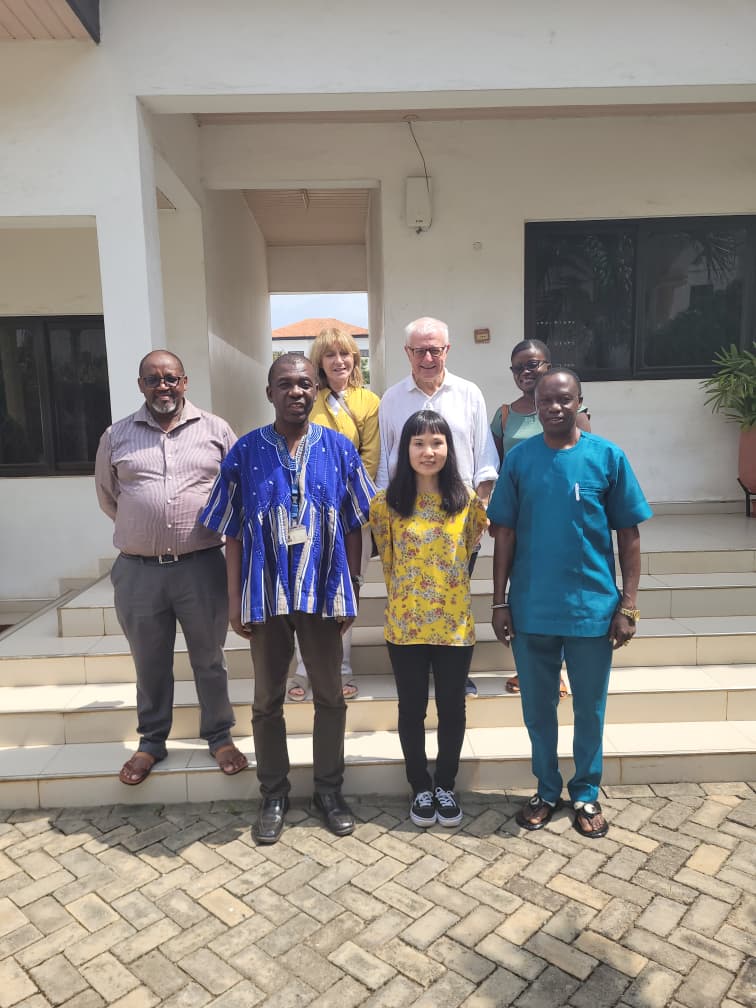
The Teaching and Learning Approaches Across Borders (TALAAB) initiative, an international research and professional learning community, has paid a courtesy call on the Provost of the College of Education, University of Ghana, to deepen collaboration on context-responsive teaching and learning.
The delegation of scholars and education development specialists from Africa, Asia and Europe was received on behalf of the Provost by the College Registrar, Mr. Joseph Oduro Nkansah, who welcomed them and reaffirmed the College’s commitment to partnerships that enhance teaching, learning and research.
Established in 2020, TALAAB brings together researchers with shared interests in learner-centred pedagogy, educational aid and postcolonial education reform. Leading the delegation, Dr. Abraham Okrah, Head of the Department of Teacher Education, explained that the visit was to engage College leadership and explore avenues for sustained institutional collaboration. He noted that TALAAB is guided by an ideas-led approach, with members contributing voluntarily in pursuit of shared intellectual goals.
The initiative has strong links to the Africa–Asia University Dialogue, hosted by Hiroshima University with UNESCO support and has built partnerships with institutions including the University of Cape Coast and the University of Ghana, promoting South–South and South–North academic exchange.
TALAAB’s research focuses on learner-centred pedagogy in African education systems, examining issues of policy transfer and contextual relevance while highlighting the role of indigenous pedagogies. The group has produced peer-reviewed publications and international conference presentations in leading journals such as Comparative Education and Comparative Education Review.
As part of its engagement with the University of Ghana, TALAAB organised a seminar from 8th to 11th December, 2025. The initiative aims to expand its research, strengthen links between scholarship and education policy and integrate its findings into teacher education and academic programmes, contributing to global debates on equitable and culturally grounded education reform.